Best Knee Replacement Surgery in Indore (घुटना प्रत्यारोपण)
इंदौर में घुटना बदलने की सर्जरी (Knee Replacement)
Total & Partial Knee Replacement for Advanced Knee Arthritis
जब घुटने की गद्दी (कार्टिलेज) पूरी तरह घिस जाती है, तब घुटना बदलने की सर्जरी में खराब सतह हटाकर धातु और मेडिकल प्लास्टिक का इम्प्लांट लगाया जाता है — ताकि आप फिर से बिना दर्द चल, सीढ़ी चढ़ और बैठ सकें।
When the cartilage in your knee has worn away completely, a knee replacement removes the damaged surface and resurfaces it with a metal and polyethylene implant — so you can walk, climb stairs and sit comfortably again.
घुटना बदलने की सर्जरी क्या है?
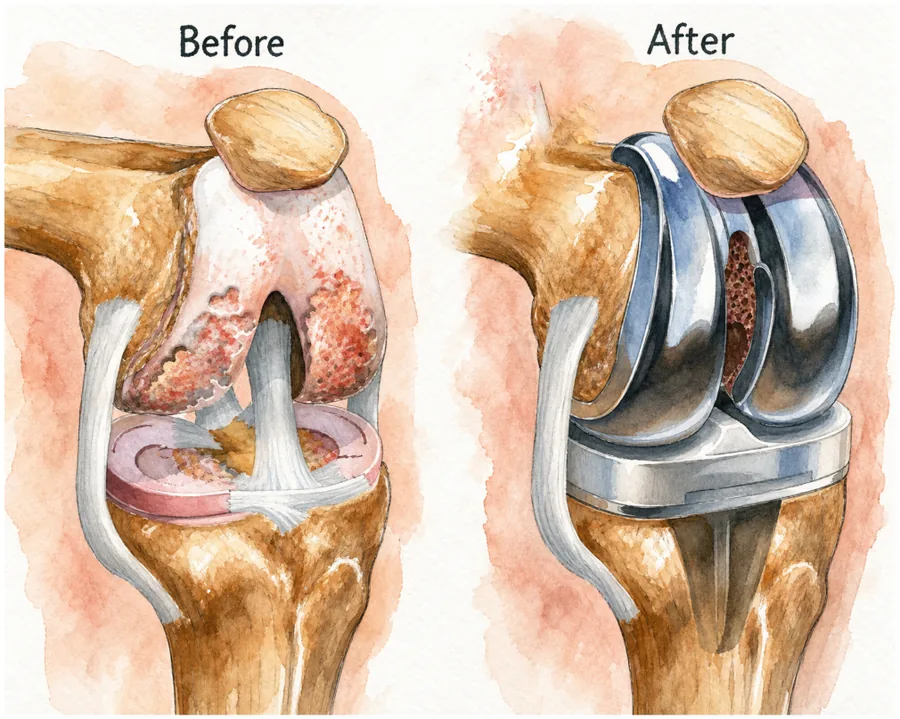
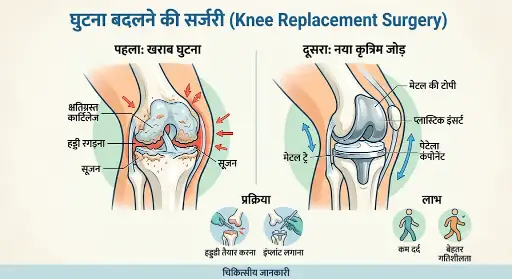
घुटना प्रत्यारोपण (Knee Replacement) में आपका पूरा घुटना निकाला नहीं जाता। केवल घिसी हुई सतह — जांघ की हड्डी के निचले सिरे, पिंडली की हड्डी के ऊपरी सिरे और घुटने की टोपी (नी-कैप) के पिछले हिस्से से कुछ मिलीमीटर खराब हड्डी और कार्टिलेज — निकालकर वहाँ इम्प्लांट लगाया जाता है।
इम्प्लांट के तीन हिस्से होते हैं: जांघ की हड्डी पर कोबाल्ट-क्रोम कैप, पिंडली की हड्डी पर टाइटेनियम ट्रे, और दोनों के बीच मेडिकल ग्रेड पॉलीएथिलीन की गद्दी जो नई कार्टिलेज का काम करती है। आपके अपने लिगामेंट और मांसपेशियाँ ही घुटने को ताकत और संतुलन देती रहती हैं।
दुनिया भर के रजिस्ट्री आँकड़े बताते हैं कि दस में से नौ से ज़्यादा आधुनिक घुटना प्रत्यारोपण सर्जरी के 15 साल बाद भी अच्छी तरह काम करते रहते हैं।
What is a knee replacement?
A knee replacement (knee arthroplasty) is not the removal of your knee joint. Only the worn-out surface — a few millimetres of damaged bone and cartilage from the lower end of the thigh bone, the upper end of the shin bone and the back of the knee cap — is trimmed away and resurfaced with a precisely shaped implant.
The implant has three parts: a cobalt-chrome femoral component that caps the thigh bone, a titanium tibial tray on the shin bone, and a tough medical-grade polyethylene insert between them that acts as the new cartilage. Your own ligaments and muscles continue to power and stabilise the knee.
Knee replacement is one of the most predictable operations in orthopaedics. Long-term registry data from across the world shows that more than nine out of ten modern knee replacements are still working well 15 years after surgery.
घुटना बदलने की ज़रूरत कब पड़ती है?
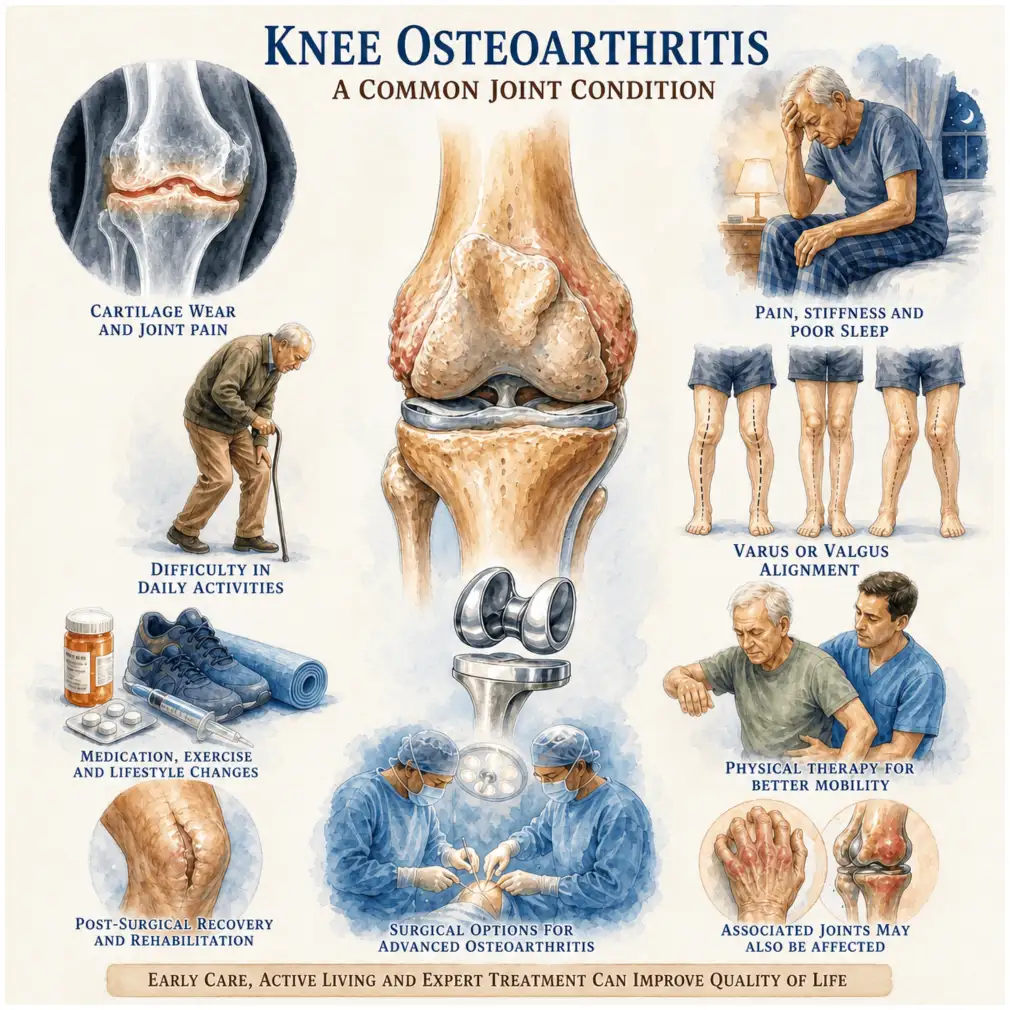
घुटना बदलना कभी पहला कदम नहीं होता। यह तभी सोचा जाता है जब गठिया इतना बढ़ चुका हो कि बाकी कोई इलाज असर न करे। सामान्य कारण:
- एक्स-रे में हड्डी से हड्डी की रगड़ (ग्रेड 3 या 4 ऑस्टियोआर्थराइटिस) — जोड़ की जगह पूरी तरह खत्म।
- रात का दर्द और आराम में भी दर्द — जो नींद तोड़ दे या बैठे रहने पर भी बना रहे।
- 10–15 मिनट से कम चल पाना, या घर के अंदर भी छड़ी/वॉकर की ज़रूरत पड़ना।
- बढ़ती टेढ़ापन — घुटना बाहर की ओर मुड़ना (धनुष पैर) या अंदर की ओर, या पूरा सीधा न होना।
- बिना सर्जरी वाला इलाज असफल — 6 महीने या उससे ज़्यादा फिजियोथेरेपी, वज़न कम करना, दवा और इंजेक्शन के बाद भी राहत नहीं।
- पुरानी चोट या फ्रैक्चर के बाद का गठिया, या रुमेटॉइड जैसे सूजन वाले गठिया से हुआ नुकसान।
When do you actually need a knee replacement?
A knee replacement is never the first step. It is considered only when advanced arthritis has stopped responding to everything else. Typical indications are:
- Bone-on-bone arthritis on X-ray (Grade 3 or 4 osteoarthritis) with complete loss of joint space.
- Night pain and rest pain — pain that wakes you up or continues even when you are sitting still.
- Walking distance below 10–15 minutes, or dependence on a stick or walker for ordinary indoor activity.
- Progressive deformity — the knee is turning bow-legged (varus) or knock-kneed (valgus), or will not straighten fully.
- Failed conservative treatment — 6 months or more of physiotherapy, weight reduction, painkillers, and injections have not helped.
- Post-traumatic arthritis after an old fracture, or arthritis from rheumatoid disease and other inflammatory conditions.
घुटना प्रत्यारोपण के प्रकार
टोटल नी रिप्लेसमेंट (TKR)
घुटने के तीनों हिस्सों की सतह बदली जाती है। पूरे घुटने में फैले गठिया के लिए सबसे आम और मानक सर्जरी।
पार्शियल (आधा) रिप्लेसमेंट
घुटने का केवल खराब आधा हिस्सा बदला जाता है। छोटा चीरा, तेज़ रिकवरी, ज़्यादा प्राकृतिक अहसास — पर यह तभी संभव है जब गठिया एक ही हिस्से तक सीमित हो और लिगामेंट ठीक हों।
दोनों घुटनों की सर्जरी
एक ही बार में या कुछ हफ़्तों के अंतर पर। जब दोनों घुटने बराबर खराब हों और सेहत अच्छी हो — निर्णय एनेस्थीसिया जाँच के बाद लिया जाता है।
रिवीजन सर्जरी
पहले लगाया गया इम्प्लांट ढीला, घिसा, संक्रमित या अस्थिर होने पर दोबारा सर्जरी — इसमें लंबे स्टेम वाले इम्प्लांट और बोन ग्राफ्ट लगते हैं।
कंप्यूटर/जिग से एलाइनमेंट
इम्प्लांट को शरीर की सीध में एक-दो डिग्री की सटीकता से लगाया जाता है। सही एलाइनमेंट ही तय करता है कि घुटना कितने साल चलेगा।
हाई टिबियल ऑस्टियोटॉमी
कम उम्र के मरीज़ों में, जब गठिया घुटने के एक ही हिस्से में हो, हड्डी की सीध बदलकर अपना जोड़ बचाया जाता है और रिप्लेसमेंट कई साल टल जाता है।
Types of knee replacement
Total Knee Replacement (TKR)
All three compartments of the knee are resurfaced. The standard operation for widespread arthritis, and the most commonly performed knee replacement.
Partial / Unicompartmental (UKR)
Only the damaged half of the knee is replaced. Smaller incision, faster recovery, more natural feel — but only suitable when arthritis is confined to one compartment and the ligaments are intact.
Bilateral Knee Replacement
Both knees, either in the same sitting or staged a few weeks apart. Sensible when both knees are equally bad and general health is good — the decision is made after a full anaesthetic assessment.
Revision Knee Replacement
Redoing a knee replacement that has loosened, worn out, become infected or unstable, usually with longer stemmed implants and bone grafting.
Computer / Jig-assisted Alignment
Alignment guides are used to place the implant within a degree or two of the mechanical axis. Correct alignment is the single biggest factor in how long a knee replacement lasts.
High Tibial Osteotomy
For younger patients with arthritis in only one half of the knee, the bone is realigned instead of replaced — the joint is preserved and replacement is postponed by years.
सर्जरी की पूरी प्रक्रिया, चरण दर चरण
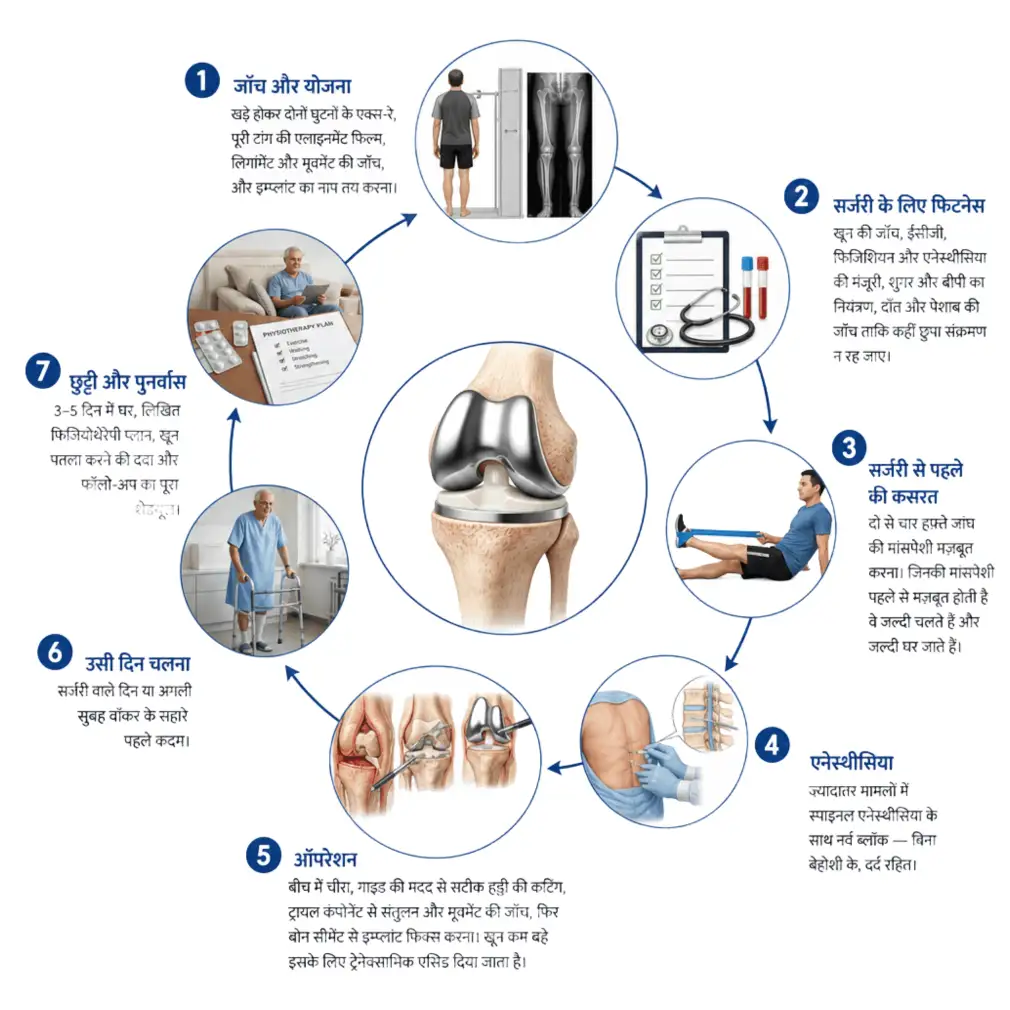
- जाँच और योजना खड़े होकर दोनों घुटनों के एक्स-रे, पूरी टांग की एलाइनमेंट फिल्म, लिगामेंट और मूवमेंट की जाँच, और इम्प्लांट का नाप तय करना।
- सर्जरी के लिए फिटनेस खून की जाँच, ईसीजी, फिजिशियन और एनेस्थीसिया की मंज़ूरी, शुगर और बीपी का नियंत्रण, दाँत और पेशाब की जाँच ताकि कहीं छुपा संक्रमण न रह जाए।
- सर्जरी से पहले की कसरत दो से चार हफ़्ते जांघ की मांसपेशी मज़बूत करना। जिनकी मांसपेशी पहले से मज़बूत होती है वे जल्दी चलते हैं और जल्दी घर जाते हैं।
- एनेस्थीसिया ज़्यादातर मामलों में स्पाइनल एनेस्थीसिया के साथ नर्व ब्लॉक — बिना बेहोशी के, दर्द रहित।
- ऑपरेशन बीच में चीरा, गाइड की मदद से सटीक हड्डी की कटिंग, ट्रायल कंपोनेंट से संतुलन और मूवमेंट की जाँच, फिर बोन सीमेंट से इम्प्लांट फिक्स करना। खून कम बहे इसके लिए ट्रेनेक्सामिक एसिड दिया जाता है।
- उसी दिन चलना सर्जरी वाले दिन या अगली सुबह वॉकर के सहारे पहले कदम।
- छुट्टी और पुनर्वास 3–5 दिन में घर, लिखित फिजियोथेरेपी प्लान, खून पतला करने की दवा और फॉलो-अप का पूरा शेड्यूल।
What happens, step by step
- Assessment and planning Standing X-rays of both knees with full-length alignment views, examination of ligaments and range of motion, and templating of the implant size.
- Fitness for surgery Blood tests, ECG, physician and anaesthetist clearance, control of blood sugar and blood pressure, dental and urine screening to rule out any hidden source of infection.
- Pre-habilitation Two to four weeks of quadriceps strengthening before surgery. Patients who go in with stronger thigh muscles walk better and go home sooner.
- Anaesthesia Usually spinal anaesthesia with a nerve block, so you are pain-free without general anaesthesia in most cases.
- The operation A midline incision, precise bone cuts using alignment guides, trial components to check balance and movement, then the final implant fixed with bone cement. Tranexamic acid is used to reduce blood loss.
- Same-day mobilisation You stand and take your first steps with a walker on the day of surgery or the next morning.
- Discharge and rehabilitation Home in 3–5 days with a written physiotherapy plan, blood thinners for clot prevention and a follow-up schedule.
सर्जरी के बाद रिकवरी का समय
| सर्जरी के बाद समय | आप क्या कर रहे होंगे |
|---|---|
| दिन 0–1 | वॉकर के सहारे खड़े होना और कुछ कदम चलना; बिस्तर पर टखने और जांघ की कसरत। |
| दिन 2–5 | खुद बाथरूम तक जाना, 3–4 सीढ़ी चढ़ना, घुटना लगभग 90 डिग्री मोड़ना। घर के लिए छुट्टी। |
| दूसरा हफ़्ता | टाँके या स्टेपल निकालना। ज़्यादातर मरीज़ घर के अंदर बिना सहारे चलने लगते हैं। |
| 4–6 हफ़्ते | वॉकर छूट जाता है, घुटना 110–120 डिग्री मुड़ता है, दाहिना घुटना ठीक हो तो गाड़ी चलाना शुरू। |
| तीसरा महीना | ऑफिस का काम, मंदिर जाना, बाज़ार में चलना, हल्की साइकिलिंग और तैराकी। |
| 6–12 महीने | सूजन पूरी तरह खत्म, ताकत सामान्य, और घुटना अपना सा लगने लगता है। |
Recovery timeline after knee replacement
| Time after surgery | What you should be doing |
|---|---|
| Day 0–1 | Standing and walking a few steps with a walker; ankle pumps and static quadriceps exercises in bed. |
| Day 2–5 | Walking to the toilet independently, climbing 3–4 stairs, bending the knee to about 90 degrees. Discharge home. |
| Week 2 | Stitches or staples removed. Walking indoors without support in most patients. |
| Week 4–6 | Walker discarded, bending to 110–120 degrees, driving a car resumed if the right knee is comfortable. |
| Month 3 | Back to office work, temple visits, market walking, light exercise cycling and swimming. |
| Month 6–12 | Swelling settles completely, stamina returns to normal, the knee starts to feel like your own. |
खर्च, जोखिम और उनसे बचाव
इंदौर में घुटना प्रत्यारोपण का खर्च किस पर निर्भर करता है
कोई एक तय कीमत नहीं होती। खर्च इस पर निर्भर करता है कि कौन सा इम्प्लांट चुना गया (सामान्य कोबाल्ट-क्रोम या हाई-फ्लेक्शन/ऑक्सीडाइज़्ड ज़र्कोनियम), एक घुटना या दोनों, अस्पताल का कमरा, कितने दिन भर्ती रहना पड़ा, और बीमा, CGHS, आयुष्मान भारत या कंपनी पैनल का कवर है या नहीं। भर्ती से पहले लिखित और विस्तृत अनुमान दिया जाता है ताकि बाद में कोई हैरानी न हो — परामर्श के समय ज़रूर माँगें।
जोखिम — बिना छुपाए
- संक्रमण (1% से कम) — लैमिनार फ्लो ओटी, सर्जरी से पहले दाँत और पेशाब की जाँच, शुगर का कड़ा नियंत्रण और एंटीबायोटिक से इसे कम किया जाता है।
- खून का थक्का (DVT) — उसी दिन चलना, पिंडली की कसरत और कुछ हफ़्ते खून पतला करने की दवा से बचाव।
- घुटने का जाम होना — सबसे आम टालने योग्य समस्या, और लगभग हमेशा फिजियोथेरेपी छोड़ने का नतीजा।
- इम्प्लांट का ढीला होना या घिसना — 15–20 साल बाद की समस्या, रिवीजन सर्जरी से ठीक की जा सकती है।
- चीरे के पास सुन्नपन — चीरे के बाहरी किनारे पर थोड़ी जगह हमेशा के लिए सुन्न रह सकती है, यह सामान्य और हानिरहित है।
Cost, risks and how they are minimised
What decides the cost of a knee replacement in Indore
There is no single price. The final figure depends on the implant chosen (standard cobalt-chrome versus high-flexion or oxidised zirconium), whether one or both knees are done, the type of hospital room, the length of stay, and whether you are covered by insurance, CGHS, Ayushman Bharat or a corporate panel. The clinic gives a written, itemised estimate before admission so there are no surprises — ask for it at your consultation.
Risks — stated honestly
- Infection (under 1%) — minimised by strict laminar-flow theatre discipline, pre-operative screening of teeth and urine, tight sugar control and prophylactic antibiotics.
- Blood clots (DVT) — minimised by same-day walking, calf pumps and blood thinners for a few weeks.
- Stiffness — the commonest avoidable problem, and almost always the result of skipped physiotherapy.
- Implant loosening or wear — a long-term issue after 15–20 years, treatable with revision surgery.
- Numb patch beside the scar — a small area of permanent numbness on the outer side of the incision is normal and harmless.
घुटना बदलने के बारे में भ्रांतियाँ और सच्चाई
Myths vs facts about knee replacement
अक्सर पूछे जाने वाले प्रश्न
Frequently Asked Questions
How long does a knee replacement last?
How soon can I walk after knee replacement surgery?
Can both knees be replaced at the same time?
Can I sit cross-legged or use an Indian toilet after knee replacement?
Is knee replacement covered by insurance or Ayushman Bharat?
What is the right age for knee replacement?
Can knee arthritis be treated without surgery?
Which is the best hospital in Indore for knee replacement?
अब घुटनों के हिसाब से दिन मत बिताइए
गोयल नगर या साईनाथ कॉलोनी, इंदौर के क्लिनिक पर अपने खड़े होकर लिए गए एक्स-रे लेकर आइए। आपको साफ़ जवाब मिलेगा कि घुटना बदलने की ज़रूरत है या नहीं — और अगर नहीं, तो बदले में क्या करना है।
Stop planning your day around your knees
Bring your standing X-rays to the clinic in Goyal Nagar or Sainath Colony, Indore. You will get a straight answer about whether you need a knee replacement — and if you do not, exactly what to do instead.